Archimedean solid
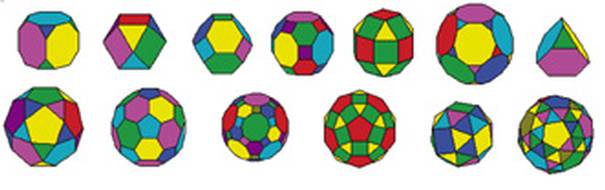
The thirteen Archimedean solids.
An Archimedean solid is a convex semiregular polyhedron – a solid made from regular polygonal sides of two or more types that meet in a uniform pattern around each corner. (A regular polyhedron, or Platonic solid, has only one type of polygonal side.)
There are 13 Archimedean solids. Although they are named after their discoverer, the first surviving record of them is in the fifth book of the Collection of Pappus of Alexandria. The duals of the Archimedean solids (made by replacing each face with a vertex, and each vertex with a face) are commonly known as Catalan solids. Apart from the Platonic and Archimedean solids, the only other convex uniform polyhedra with regular faces are prisms and antiprisms. This was shown by Johannes Kepler, who also gave the names generally used for the Archimedean solids. See also Johnson solids.
| The Archimedean solids | |||
|---|---|---|---|
| name | vertices | faces | edges |
| truncated tetrahedron | 12 | 8 | 18 |
| truncated cube | 24 | 14 | 36 |
| truncated octahedron | 24 | 14 | 36 |
| truncated dodecahedron | 60 | 32 | 90 |
| truncated icosahedron | 60 | 32 | 90 |
| cuboctahedron | 12 | 14 | 24 |
| icosidodecahedron | 30 | 32 | 60 |
| snub dodecahedron | 60 | 92 | 150 |
| rhombicuboctahedron | 24 | 26 | 48 |
| great rhombicosidodecahedron | 120 | 62 | 180 |
| rhombicosidodecahedron | 60 | 62 | 120 |
| great rhombicuboctahedron | 48 | 26 | 72 |
| snub cube | 24 | 38 | 60 |
A chemical Archimedean solid
In 2011, chemists announced that they had made a molecular sized version of the truncated octahedron. The tiny, hollow structure serves as a cage, capable of enclosing a wide variety of ions and molecules in a stable configuration. It also helps in the synthesis of substances that wouldn't otherwise form.
Michael Ward of New York University, and colleagues, built their cage, which has eight hexagonal and six square faces, by combining two types of carefully-designed molecular "tiles", one made of chemical groups known as guanidiniums, the other ringed by sulfonate groups. These were assembled into the truncated octahedron with the formation 72 hydrogen bonds.1
Reference
1. Liu, Y., Hu, C., Comotti, A, and Ward, M. "Supramolecular Archimedean Cages Assembled with 72 Hydrogen Bonds", Science, 333 (no. 6041), 436–440 (2011).