
Atlas
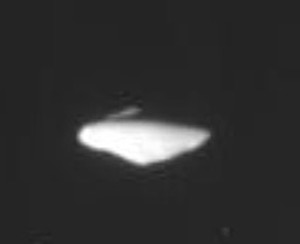
Atlas, as imaged by Cassini on 8 June 2005.
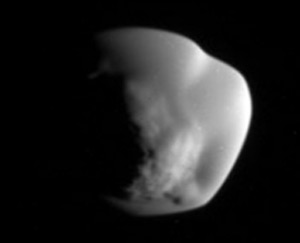
Atlas, as imaged by Cassini on 12 June 2007, from over the moon's south pole.
Atlas is one of the innermost moons of Saturn. It was discovered by Richard Terrile in 1980 from Voyager 1 photos and is also known as Saturn XV.
Atlas orbits near the outer edge of the A-ring (see Saturn's rings) and it was originally suspected of acting as a shepherd moon for this ring. However, it is now known that the outer edge of the A-ring is kept sharp due to a 7:6 orbital resonance with the larger but more distant moons Janus and Epimetheus.
Images taken by the Cassini spacecraft have shown that Atlas has very prominent equatorial ridge, which makes the moon saucer-shaped. The most likely cause of this structure is ring material that has been swept up by the moon as it travels around its orbit.
| discovery | 1980, by R. Terrile/Voyager 1 |
| semimajor axis | 137,670 km (85,560 mi) |
| diameter | 46 × 38 × 19 km (29 × 24 × 12 mi) |
| orbital period | 0.602 day (14 h 27 min) |
| orbital eccentricity | 0.001 |
| orbital inclination | 0.00° |
| visual albedo | 0.4 |
Disambiguation
The star Atlas, or 27 Tauri, is the second brightest star in the Pleiades, with a visual magnitude of 3.63, is also known as Atlas.
The Atlas rocket is an important launch vehicle in America's space program.
The ATLAS particle detector is one of several particle detector experiments associated with the Large Hadron Collider – the world's largest particle accelerator – at CERN.

