
Bohr, Niels Henrik David (1885–1962)
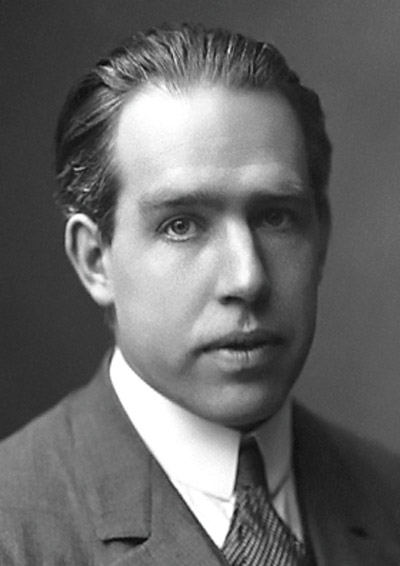
Niels Bohr was a Danish physicist who played a major role in the development of quantum theory. He was the first person to apply it with success to the problem of atomic structure (see Bohr atom).
Bohr worked in Britain with J. J. Thomson at Cambridge and Ernest Rutherford at Manchester before returning in 1916 to teach theoretical physics at the University of Copenhagen. He escaped from German-occupied Denmark during World War 2 and worked briefly on developing the atom bomb in the United States. He later returned to Copenhagen and worked for international cooperation.
Bohr used the quantum theory to explain the hydrogen spectrum and in the 1920s helped develop the so-called Copenhagen interpretation. He was awarded the 1922 Nobel Prize in Physics for his work on atomic structure. During the 1930s his Institute of Theoretical Physics in Copenhagen became a haven for many Jewish and other physicists expelled by Hitler. In 1939 he took news of Lise Meitner's and Otto Hahn's uranium fission work to the United States and started the process that culminated in the manufacture of the atomic bomb. Bohr himself later worked at Los Alamos on the bomb, after escaping from German-occupied Denmark. A fervent advocate of atomic energy for peaceful uses, he organized the first Atoms for Peace Conference in 1955; in 1957 received the first Atoms for Peace Award.
His son, Aage Niels Bohr (1922–2099), shared the 1975 Nobel Prize in Physics with B. Mottleson and J. Rainwater for contributions made to the physics of the atomic nucleus.
Copenhagen interpretation
Quantum mechanics takes a metaphysical approach toward understanding subatomic particles, providing physicists with tools to conduct experiments that might provide insights into their behavior. Yet quantum mechanics at times appears bizarre even to some physicists, and one of its most bizarre aspects is the so-called many worlds theory, which suggests that, for each outcome of any given action, the universe can split it in two, allowing for the quantum particles in the event to behave in two entirely different ways. Starting in 1924, at the University of Copenhagen, Bohr set out to try to explain this seeming contradictory duality. In what he called the Copenhagen interpretation, he theorized that quantum particles do not exist solely in one state or another, but in all of their possible states at the same time. This state is referred to by physicists as coherent superposition.
Moreover, every subatomic particle has two aspects, a wave aspect and particle aspect, which may be compared to the two sides of the same coin. And just as a coin tossed in the air can land only one side, so too a subatomic particle can behave as either a wave or a particle, though never both at the same time. Bohr's interpretation suggests that if a particle were to be observed in its natural state, the observer would see it only after it has been forced to "choose" which path to take – that path then becomes the "observed state." Consequently, electrons in identical experiments are capable of behaving differently, depending on which of their two aspects comes into play.
