electron bombardment thruster
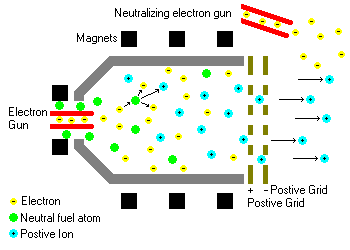
An electron bombardment thruster, also known as an electrostatic ion thruster, is one of the most promising forms of electric space propulsion and one of only two forms of ion propulsion currently employed aboard spacecraft, the other being the Hall effect thruster.
How it works
In an electron bombardment thruster, a gas propellant enters a discharge chamber at a controlled rate. A hot, hollow cathode (negative electrode) at the center of the chamber emits electrons, which are attracted to a cylindrical anode (positive electrode) around the walls of the chamber. Some of the electrons collide with and ionize atoms of the propellant, creating positively-charged ions. These ions are then drawn toward a high-voltage electric field set up between two closely-spaced grids at the downstream end of the chamber. These grids contain numerous tiny lined-up holes so that they serve as porous electrodes. The ions are drawn through the first grid (the screen grid), are accelerated in the narrow gap between the first and second grid (the accelerator grid), and then pass through the second grid as a fast-moving ion beam. On the downstream side of the accelerator grid, electrons are injected back into the beam before it is expelled in order that the spacecraft remains electrically neutral. If only positively-charged ions were allowed to escape, the vehicle would become more and more negatively-charged until it prevented the thruster working at all.
Research and development
Early research on this type of engine was carried out in the 1960s and 1970s used mercury or cesium gas as the propellant; an important example involved the SERT (Space Electric Rocket Test) spacecraft. However, it was found that the ions of these elements tended to adhere to and erode the grids. Further work showed that ions of the heavy inert gas xenon suffered less from this problem, and resulted in good engine efficiency with minimum erosion of the ion optics. Xenon has thus become the propellant of choice in all modern ion propulsion systems, both of the electron bombardment and Hall effect variety.
The two most significant operational forms of electron bombardment thruster are the NSTAR, developed by NASA, and used aboard Deep Space 1, and XIPS (xenon-ion propulsion system), developed by Hughes (now part of Boeing), and used for station-keeping on some geosynchronous satellites. NASA is also developing a 20–50 kW electron bombardment thruster, called HiPEP, which will have higher efficiency, specific impulse, and lifetime than NSTAR.