
endothelial cell
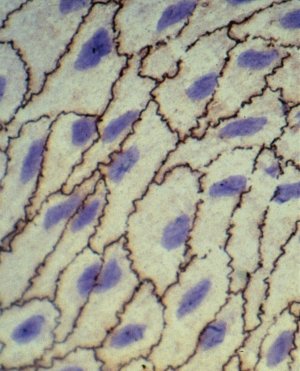
A surface preparation of arterial endothelium. The endothelial nuclei appear blue; the cell boundaries are stained black with silver nitrate. Credit: School of Anatomy and Human Biology, University of Western Australia.
An endothelial cell is a squamous (flattened) cell, large numbers of which make up the lining of blood vessels and lymphatic vessels. Endothelial cells line the entire circulatory system, from the heart to the smallest capillary. A layer of epithelial cells is called an endothelium.
An individual endothelial cell has a central nucleus, is very flat (only about 1-2 micrometers thick), and measures some 10-20 micrometers in diameter. The intercellular junctions between endothelial cells overlap, thus helping to make a tight seal, for example in the wall of a blood vessel.
Endothelial cells play a key role in many phenomena to do with blood and blood vessels, including:
· Formation of new blood vessels (angiogenesis)
· Vasoconstriction and vasodilation, and hence the control of blood
pressure
· Blood clotting (thrombosis
and fibrinolysis)
· Atherosclerosis
· Inflammation and swelling (oedema)
Endothelial cells also control the movement of substances, and the passage of white blood cells (leukocytes), into and out of the bloodstream.
Some organs have highly differentiated endothelial cells for carrying out specialized filtering functions. Examples of such unique endothelial structures include the glomerulus of the kidney and the blood-brain barrier.
See also endothelium.

