
14 Herculis
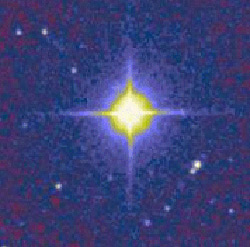
14 Herculis. Image: Digitized Sky Survey.
14 Herculis is an orange-yellow K-star around which an exoplanet has been found. The heavy element abundance of 14 Herculis is greater than that of the Sun and the discovery that it has a massive planet lends support to the idea that such large worlds tend to form in heavy element enriched environments. The planetary companion of 14 Herculis has a mass almost five times that of Jupiter and moves in an eccentric orbit about its host star with a period of 4.9 years. The discovery of second possible planet around 14 Herculis was announced in 2005.
| Host star | |
|---|---|
| distance | 59 light-years (18.1 pc) |
| spectral type | K0V |
| apparent magnitude | 6.67 |
| temperature | 4,980 °C (5,250 K) |
| luminosity (Sun=1) | 0.75 |
| mass (Sun=1) | 0.79 |
| metallicity ([Fe]/[H]) | 0.35 |
| position | RA 16h 10m 24.3s, Dec +43° 49' 03.5" |
| other designations | HD 145675, HIP 79248, Gl 614, BD+44 2549 |
| Planet | |
|---|---|
| mass (Jupiter=1) | 4.74 ± 0.06 |
| semimajor axis | 2.8 AU (420 million km, 260 million mi) |
| orbital period | 1796.4 ± 8.3 days |
| eccentricity | 0.338 ± 0.011 |
| discovery | 1998, Mayor et al (Geneva), Haute-Provence Observatory |
| method of discovery | radial velocity |

