
Lacrosse
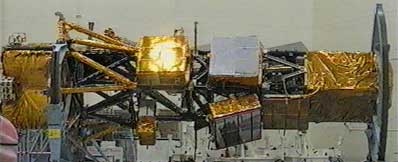
Lacrosse 4 under construction.
Lacrosse was a series of American all-weather reconnaissance satellites. Lacrosse was the first spy satellite to use synthetic aperture radar to peer through cloud to form images of the target area. Equipped with a very large radar antenna powered by solar arrays almost 50 meters across, Lacrosse may be able to resolve detail on the ground as small as one meter – good enough to identify and track major military units such as tanks or missile transporter vehicles. However, this high resolution would come at the expense of broad coverage, and would be achievable over an area of only a few tens of square kilometers. Thus Lacrosse probably uses a variety of radar scanning modes, some providing high resolution images of small areas, and other modes offering lower resolution images of areas covering several hundred square km.
The name 'Lacrosse' is used by the National Reconnaissance Office to refer to all variants of this satellite; the name "Onyx" is sometimes used to refer to the two most recent members of the series. NASA's Magellan Venus probe, built by the same prime contract, Martin Marietta was thought to have similar capabilities to Lacrosse.
| Lacrosse 1 | Lacrosse 2 | Lacrosse 3 | Lacrosse 4 | Lacrosse 5 | |
| launch date | Dec 2, 1988 | Mar 8, 1991 | Oct 24, 1997 | Aug 17, 2000 | Apr 30, 2005 |
| launcher | Shuttle, STS-27 | Titan IV-A | Titan IV-A | Titan-IVB | Titan-IVB |
| launch site | Cape Canaveral | Vandenberg | Vandenberg | Vandenberg | Cape Canaveral |
| orbit | 447 × 437 km × 57° | 662 × 420 km × 68° | 679 × 666 km × 57° | 695 × 689 km × 68° | 718 × 712 km × 57° |
| mass | n/a | n/a | n/a | 14,500 kg | 16,000 kg |
| status | deorbited 1997; mission fulfilled |
active | active | active | active |
| notes | NORAD no.19671 | NORAD no. 21147; first West coast launch of Titan IV |
NORAD no.25017; replacement for Lacrosse 1 |
NORAD no.26473; orbit adjusted to 675 x 572 km x 68° |
NORAD no.28646 |

