
M16 (NGC 6611)
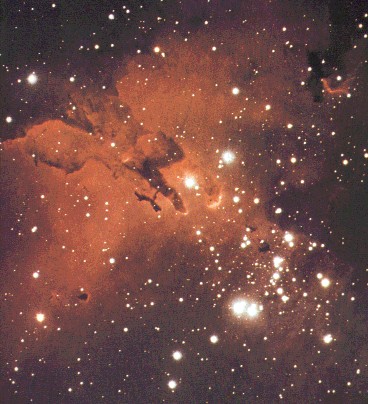
M16. Image courtesy: SED.
M16 (NGC 6611) is an open cluster in the constellation Serpens, discovered by Philippe Loys de Chéseaux in 1745–1746. M16 (NGC 611) formed, some 5.5 million years ago, from the interstellar cloud of gas and dust that it makes visible today as the Eagle Nebula (IC 4703). This famous nebula, ionized and illuminated by the hot, young O stars of M16, is still the scene of active star formation. The brightest star of M16 is of visual magnitude 8.24.
| visual magnitude | 6.4 |
| angular size | 7' |
| linear size | 15 light-years |
| distance | 7,000 light-years |
| position | RA 18h 18.8m, Dec -13° 47' |

