
vegetation on Mars
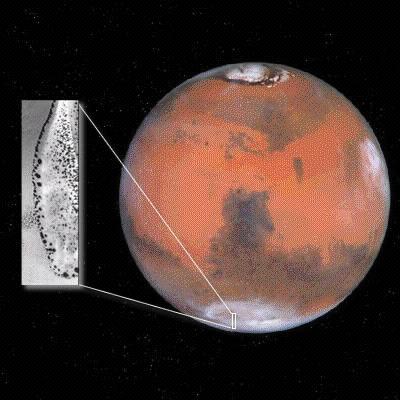
Images from Mars Global Surveyor (MGS) show dark spots near the south pole of Mars in early spring which a team of Hungarian scientists claims are a sign of Martian plant life. This image consists of an MGS photo superimposed on a Hubble photo of Mars; however, the location of the former is shown indicatively rather than accurately. Credit: ESA/Medialab.

The location and shape of the spots poses challenges for a non-biological explanation. (A) Spots develop on the dark dunes rather than on the stony soil nearby. (B) Spots are also elliptical in shape or even (C) fan-shaped. Credit: NASA/JPL/Malin Space Science Systems.
The possibility of life on Mars was discussed as early as the mid-eighteenth century by Johann Lambert who proposed that the vegetation was red – an idea later endorsed by Flammarion. By the second half of the 19th century, some observers such as E. Liais began to suspect that the seasonal variations in Martian surface features might be due to the alternate growth and recession of vast tracts of vegetation. This thesis was embraced by Lowell as part of his grand scheme of intelligently constructed canals. However, as it gradually became clear that the environment of Mars was probably too hostile for advanced forms of animal or plant life, astronomers in the pre-Space Age decades of the twentieth century came to suspect that, at most, lowly, lichen-like vegetation would be found. As late as the spring of 1956, Gerard Kuiper, using the 82-inch reflector at the McDonald Observatory, noted a "touch of moss green" in some of the equatorial regions. Such reports prompted a search for the spectroscopic signature of chlorophyll which, for a brief period in the late 1950s, through the work of Sinton, appeared to have been successful. In the USSR, at the same time, Gavriil Tikov was similarly engaged in an effort to find traces of Martian plant life spectroscopically.
The modern search
In 2001, three Hungarian researchers, Tibor Ganti, Eoers Szathmary, and Andras Horvath from the Planetarium and the Institute for Advanced Study, Budapest, claimed to have found evidence of vegetation in some of the Mars Global Surveyor (MGS) images. Large groups of dark spots in craters in the south polar region of Mars (see photo) which spread every Martian spring could prove there is life on Mars, they said. The team studied 60,000 photographs taken by MGS before concluding that the organisms lived by photosynthesis. "The organisms live between the surface of Mars and a thick ice cover that isolates them extremely well from Martian temperatures of around –120°C," said Ganti. "When the spring comes and light penetrates the ice, these organisms absorb the energy of light and warm up themselves. Under the ice, temperatures rise to slightly above 0°C. A thin inner layer of the ice melts, thus creating the conditions of life. In the summer, when the whole ice cover melts and the water evaporates, they dry out again," he said. The dark spots start spreading in the spring, varying from 10 meters to several hundred m in diameter. "The organisms could be algae or lichen at the most, similar to organisms that can be found on tundra close to the earth's North and South Poles," according Ganti. However, other, non-biological explanations have been put forward. For example, it has been noted that images taken by the Giotto probe showed that the black color of cometary nuclei is formed when a mixture of carbon and water ice is exposed to ultraviolet radiation.
A separate recent claim of Martian vegetation came from Carol Stoker and Pascal Ashwanden, both of NASA Ames Research Center, who reported the following at a poster session of the Second Astrobiology Science Conference at NASA Ames Research Center in April 2002:
The Superpan, an image product from the Pathfinder lander camera, is a multispectral panorama of the Pathfinder landing site acquired in 15 wavelengths in the spectral range 440-1100 nm [nanometers]. We have performed an automated search of the Superpan image cubes for the spectral signature associated with chlorophyll. First, images were calibrated to radiance values and then the multispectral images were co-registered to subpixel accuracy. An automated pixel-to-pixel search was performed on a 3-filter set of images (530 nm, 670 nm, 980 nm) to identify pixels where the following condition was met: 530 nm > 670 nm, and 980nm > 670 nm. Thus, we searched for the spectral signature associated with red light absorption by chlorophyll. When this case was met by the search routine, we plotted a full spectrum for the involved pixels and carefully examined the images. The condition was met for small areas in six image cases. All of these cases occur in near field images, where resolution is highest. Four of the cases occur on the spacecraft and appear to be associated with spacecraft structure. Two intriguing cases occur in small areas on the ground near the spacecraft.
The weight of scientific opinion currently remains very much against the possibility of surface life of any kind on Mars. By contrast, opinion is more or less evenly divided on the issue of past life and of extant subterranean Martian life. For a more general discussion, see Mars, life.

