
Montgolfier brothers
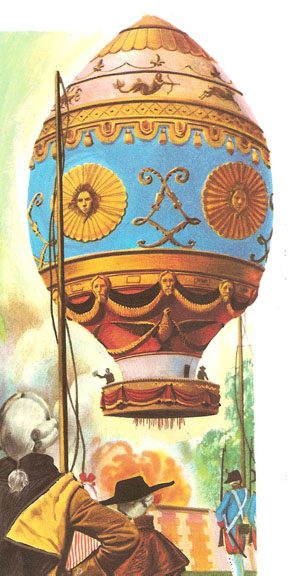
21 November 1783: the magnificently painted Montgolfière is loosed from its two supporting masts and slowly rises, carrying the first humans ever to make an air flight. The balloon, carrying Jean-Francois Pilatre de Rozier and the Marquis of d'Arlandes, flew across Paris for some 14 kilometers (9 miles) across Paris. The flight is believed to have lasted 23 minutes, and the balloon reached a height of 900 meters (3,000 feet). Made of paper-lined linen and coated with alum to reduce the fire risk, the balloon was 15 meters (50 ftee) high, and weighed 785 kilograms (1,730 pounds). The air inside was heated by a large mass of burning straw resting on a wire grid in the center of the gallery.
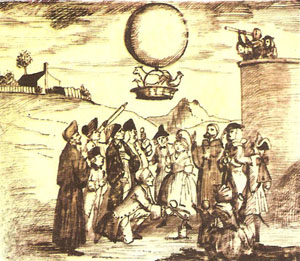
On 24 September 1983, the first balloon flight took place carrying living things.
French brothers Joseph Michel Montgolfier (1740–1810) and Jacques Étienne Montgolfier (1745–1799) invented the hot-air balloon.
Prehistory of flight
In Greek legend, Icarus and his father tried to escape from the labyrinth of the Cretan Minotaur with the help of enormous wings held in place by wax. Unfortunately, Icarus flew so near the Sun that the wax melted and he plunged to his death in the sea.
This is only one of the many ancient myths and legends that express the human desire to fly; gods, heroes, and beasts were often equipped with bird-like wings. Later, intrepid but aerodynamically-challenged enthusiasts jumped off towers and other exposed heights, hoping to become airborne by artificial wings or voluminous cloaks.
In all these stories and experiments the human imagination had been fired by seeing birds flying, and this was to lead eventually to the invention of the airplane, or the flight of a body that is heavier than air. But first, unexpectedly came the invention of the balloon, or lighter-than-air flight.
From time to time there had been suggestions as to how an airship could be made lighter than air, but these were thought to be impracticable and nothing was done. The final solution was reached by a combination of two quite separate discoveries. In 1766 the English scientist Henry Cavendish isolated the gas hydrogen from air and examined its properties. He found that it was more than 14 times lighter than air.
The importance of this discovery for aerostation (from the Greek aer, air; and sta, stand), or lighter-than-air flight, wasn't realized for 17 years, when the imaginative Montgolfier brothers led the way to the invention of the balloon – not with hydrogen, but with hot air. Joseph and Etienne Montgolfier, the sons of a well-known paper manufacturer at Annonay, near Lyons, were attracted to science.
Early experiments
One day Joseph was struck by the force exerted upwards by a fire, as bits of wood or paper rose in the air. He thought this was due to some unknown gas and that if he enclosed "a cloud in a bag" the bag would rise in the air. As an experiment, he lit a fire of paper underneath a silk bag that was open at the bottom. Just as he'd foreseen, the bag swelled (since hot air expands) and rose to the ceiling.
After a number of other experiments the two brothers staged a public demonstration in June 1783. A large crowd watched with "silent astonishment" as a balloon made of linen and lined with paper to make it airtight rose to a height of some 6,000 feet (1,830 meters). When an account of the ascent reached Paris, the physicist Jacque Charles remembered hydrogen and started experimenting with balloons filled with hydrogen instead of the mysterious "Montgolfier gas".
Flights with animals and men
In the meantime the Montgolfiers went from triumph to triumph, and on September 24, 1783, they staged a sensational ascent at Versailles before "the King (Louis XVI), Queen, and Court and innumerable people of every rank and age". What made this a special occasion was that a wicker basket containing a sheep, a cock, and a duck was hung from the 74-foot-high balloon – the first creatures ever to fly in a man-made device. The balloon rose to an altitude of about one mile (1.6 kilometers).
The next stage was to get human beings into the air. Another immense balloon was constructed, with a brazier slung in the open neck at the base. A wicker gallery for the crew was fixed round the outside. The limp balloon was suspended between two masts until it swelled over a fire of wool and straw; the fire in the brazier was then lit, so that the air would remain heated; and the first airman, Jean Pilâtre de Rozier, climbed aboard and made a four-hour captive flight (that is, with the balloon still tied to the ground). On November of the same year he made the first free flight with the Marquis d'Arlandes, traveling over Paris for some 9 miles (14 kilometers), and reaching a height of about 3,000 feet (900 meters) during the 23-minute flight. The balloon, made of paper-lined linen coated with alum to reduce the fire risk, was 50 feet (15 meters) high and weighed 1,730 pounds (785 kilograms). The age of air travel had begun.
Excitement at these achievements spread; to get a man into the air was as fantastic in those days as space flight is today, and a balloon craze swept England and France. Caricatures and motifs of balloons appeared everywhere. But by the end of 1785 the first enthusiasm waned, and the more scientific hydrogen balloon replaced the cumbersome but picturesque Montgolfière.

