
neurofibromatosis
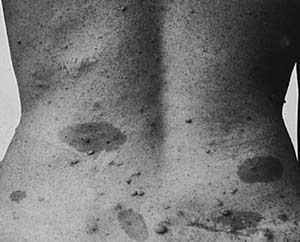
In addition to several café-au-lait spots, multiple small nodules (neurofibromas) are seen on this patient's lower back. Image credit: American Academy of Orthopedic Surgeons.
Neurofibromatosis is an uncommon genetic disorder, also called Recklinghausen's disease, which causes numerous soft, noncancerous tumors (neurofibromas) to grow on nerve tissue, producing skin and bone abnormalities. Neurofibromatosis (NF) is often diagnosed in childhood, occasionally in infancy but usually around 3-16 years of age. The effects of the disease vary widely. Some children might live almost unaffected by the condition. Although rare, others might be severely disabled.
Types and causes
There are two types of neurofibromatosis. The more common, known as neurofibromatosis 1, is usually apparent in childhood. The other type, neurofibromatosis 2, is very rare and the symptoms do not usually appear until adulthood.
Both types of NF are an autosomal dominant disorders, which means a child has a 50 percent chance of inheriting the disease if either parent has NF. It can also be the result of a mutation in the genetic material of the sperm or ovum (egg) at conception in families with no previous history of the disease. About half of cases of NF are inherited, and the other half result from genetic mutation.
Symptoms
In neurofibromatosis 1, numerous flat, pale brown patches with irregular margins, which are known as café au lait spots, develop on the skin. The growths under the skin feel soft and range in size from barely noticeable to large bumps/ There may also be numerous freckles in the regions of the armpit and groin.
Adults with neurofibromatosis 2 tend to develop tumors in the inner ear, which can affect hearing, but rarely have tumors under the skin.
Treatment
There is no currently cure for neurofibromatosis, and its progression cannot be slowed. However, surgical removal of neurofibromas may be carried out if there are complications. These may occur if growing tumors press on surrounding organs or nerves. For example, vision may be affected if a tumor develops on the optic nerve. Tumors can also cause curvature of the spine.
Anyone with neurofibromatosis should seek genetic counseling, especially when planning a pregnancy.

