
OFO (Orbiting Frog Otolith)
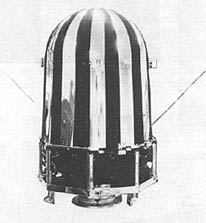
The curiously-named OFO (Orbiting Frog Otolith) was a mission undertaken by NASA's Office of Advanced Research and Technology, to study the effects of weightlessness on and the response to acceleration of that part of the inner ear which controls balance. The Frog Otolith Experiment (FOE) was developed by Torquato Gualtierotti of the University of Milan, Italy, when he was assigned so the Ames Research Center as a resident Research Associate sponsored by the National Academy of Sciences. The subjects of the experiment were two bullfrogs – animals that surprisingly have a similar inner ear structure to that of humans – which were placed in a water-filled centrifuge with microelectrodes surgically implanted in their vestibular nerves. The experimental package was designed for flight as part of the Apollo Applications Program; however, when an early Apollo flight on which OFO was intended to be flown was delayed, the OFO was equipped for flight instead on an unmanned spacecraft.
| launch date | Nov 9, 1970 |
| launch vehicle | Scout B |
| launch site | Wallops Island |
| orbit | 304 × 518 km × 37.4° |
| mass | 133 kg |

