
Proctor, Richard Anthony (1837–1888)
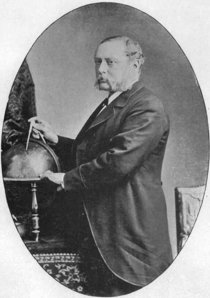
Richard Proctor was an English astronomer, educated at Cambridge, who first suggested (1873) that meteor impacts caused lunar craters, rather than volcanic action. He studied the motion of stars, their distribution, and their relation to the nebulae, produced one of the earliest maps of Mars, and took part in expeditions of 1874 and 1882 to observe the transit of Venus.
Proctor was the author of numerous books and articles on astronomy, and one of the most influential commentators of his day on the subject of life on other worlds. Only Flammarion was more prolific in popular output at this time. Proctor was frank about his reasons for entering the debate on pluralism. It was, he said "a convenient subject with which to associate scientific researches which I could in no other way bring before the notice of the general reading public." His personal financial crisis (precipitated by the collapse of the bank in which he was a major shareholder) meant that he had to write for a commercial end and, like authors today, he found that speculation about life beyond Earth sold well. In his first successful book, Other Worlds than Ours (1870), he stated his basic position that a planet should be assumed inhabited until proven lifeless. Mercury he thought possibly sterile because of its intense bombardment by solar rays. Regarding the likelihood of Venusians, he was more hopeful, while Mars "exhibits in the clearest manner the traces of adaptation to the wants of living beings such as we are acquainted with" (see Mars, life on). Moving to the giant outer planets, he dismissed the theories of both Brewster and Whewell on these bodies, arguing that their surfaces were hot as a result of immense internal sources of heat. This view was subsequently taken up by others, including Robert Ball. Proctor likened both Jupiter and Saturn to miniature suns, bestowing both warmth and life on their systems of moons. By 1875, he had incorporated these ideas into a theory of planetary evolution, powerfully influenced by the new Darwinian paradigm:
Each planet, according to its dimensions, has a certain length of planetary life, the youth and age of which including the following eras: – a Sun-like state; a state like that of Jupiter of Saturn, when much heat but little light is evolved; a condition like that of our earth; and lastly, the stage through which our moon is passing, which may be regarded as planetary decrepitude.
Although this theory suggested that the Earth might presently be the only inhabited world in the Solar System (smaller planets being dead and larger ones not yet alive), it did not mean that Proctor had moved away from pluralism. In his Our Place Among Infinities (1875), he writes:
Have we then been led to the Whewellite theory that our earth is the sole abode of life? Far from it. For not only have we adopted a method of reasoning which teaches us to regard every planet in existence, every moon, every sun, every orb in fact in space, as having its period as the abode of life, but the very argument from probability which leads us to regard any given sun as not the centre of a scheme in which at this moment there is life, forces upon us the conclusion that among the millions on millions ... of suns which people space, millions have orbs circling round then which are at this present time the abode of living creatures.
Despite his tendency toward metaphysical speculation, Proctor played an important role, as Whewell had done and as Flammarion was doing in France, in shifting the extraterrestrial life debate onto a more scientific footing.

