prostaglandin
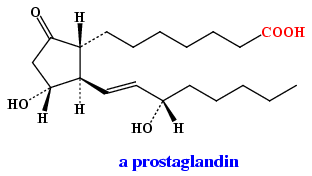
A prostaglandin is any of a group of lipid compounds that are derived from essential fatty acids (linoleic, linolenic, and arachidonic acids) and have important physiological effects in the animal body. Prostaglandins have been found in most body tissues and are produced as needed rather than being stored. Although technically they are hormones, they are not usually classified as such.
Prostaglandins take part in a wide range of body functions, including the contraction and relaxation of smooth muscle, the dilation and constriction of blood vessels, control of blood pressure, and modulation of inflammation. The greatest concentration of them occurs in semen. Several prostaglandins have been shown to induce fever, possibly by participating in the temperature-regulating mechanisms in the hypothalamus. The fact that aspirin and other non-steroidal anti-inflammatory drugs have been shown to inhibit prostaglandin synthesis may account for their usefulness in reducing fever and inflammation. Natural and synthetic prostaglandins are used to induce labor in humans and domestic animals.
Every prostaglandin contains 20 carbon atoms, including a 5-carbon ring. The prostaglandins together with the thromboxanes form the prostanoid class of fatty acid derivatives; the prostanoid class is a subclass of eicosanoids.