
SAS (Small Astronomy Satellite)
SAS (Small Astronomy Satellite) was a series of NASA spacecraft placed in orbit in the 1970s to observe celestial X-ray and gamma-ray sources. All were launched from San Marco.
SAS-1
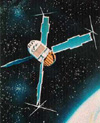 |
SAS-1 was the first Earth-orbiting mission dedicated to X-ray astronomy. Launched from the San Marco platform off the coast of Kenya on the seventh anniversary of Kenyan independence, SAS-1 was renamed "Uhuru" which is Swahili for "freedom." It carried out observations in the 2–20 keV energy range, discovering 200 X-ray sources and finding evidence of the first known black hole. It stopped operating on 5 April 1979. Also known as Explorer 42.
SAS-2
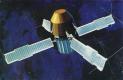 |
SAS-2 was a gamma-ray astronomy satellite sensitive in the energy range 20 MeV-1 GeV. SAS-2 provided the first detailed look at the gamma-ray sky, established the high energy component of diffuse celestial radiation, and enabled a correlation of the gamma-ray background with galactic structural features. On 8 June 1973, a failure of the spacecraft's low-voltage power supply ended its mission. Also known as Explorer 48.
SAS-3
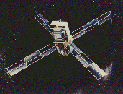 |
SAS-3 was an X-ray astronomy satellite with three major scientific objectives: to fix the location of bright X-ray sources to an accuracy of 15 arcsec, to study selected sources over the energy range 0.1–55 keV, and to search the sky continuously for X-ray novae, flares, and other transient (short-lived) phenomena. It stopped operating in 1979. Also known as Explorer 53.
| spacecraft | launch date | launch vehicle | orbit | mass (kg) |
| SAS-1 (Uhuru) | Dec 12, 1970 | Scout B | 521 × 570 × 3° | 143 |
| SAS-2 | Nov 15, 1972 | Scout D | 526 × 526 × 1° | 185 |
| SAS-3 | May 7, 1975 | Scout F | 498 × 507 × 3° | 195 |

