
Sakigake
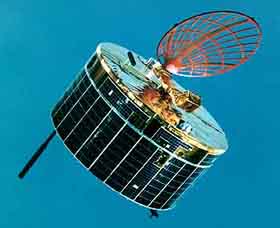
Sakigake is a Japanese prototype interplanetary spacecraft launched by ISAS (Institute of Space and Astronautical Science) to encounter Halley's Comet. It was identical to Suisei except for its payload which consisted of three instruments to measure plasma wave spectra, solar wind ions, and interplanetary magnetic fields. Like Suisei, it was designed to test basic technology for Japanese deep space missions, including communication and attitude control and determination, as well as gather scientific data. Sakigake successfully flew within 7 million kilometers of Halley's Comet on 11 March 1986, and swept past Earth on 8 January 1992, coming as close as 88,997 kilometers – the first Japanese planetary flyby. However, controllers lost contact with the probe in November 1995, cutting short its extended mission which would have taken it past comet Honda-Mrkos-Pajdusakova in 1996 and Giacobini-Zinner in 1998. Sakigake means "pioneer."
| launch date | Jan 7, 1985 |
| launch vehicle | M-3S |
| launch site | Kagoshima |
| mass | 141 kg |

