
Suisei
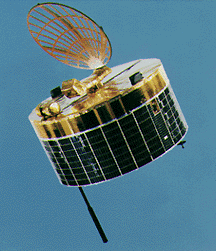
Suisei was a Japanese probe, launched by ISAS (Institute of Space and Astronautical Science), that rendezvoused with Halley's Comet on 8 March 1986. It was identical to Sakigake apart from its payload: a CCD (charge-coupled device) ultraviolet imaging system and a solar wind instrument. The main goal of the mission was to take ultraviolet (UV) pictures of the hydrogen corona for about 30 days before and after Halley's descending crossing of the ecliptic plane. Measurements of the solar wind were taken over a much longer period. Suisei began UV observations in November 1985, producing up to six images per day. The spacecraft encountered Halley on the sunward side at 151,000 kilometers during 8 March 1986, suffering only two dust impacts. During 1987 ISAS decided to guide Suisei to a November 1998 encounter with Comet Giacobini-Zinner, but due to depletion of the hydrazine, this, as well as plans to fly within several million km of Comet Tempel-Tuttle in February 1998 were cancelled. Suisei, which means "comet," was known before launch as Planet-A.
| launch date | Aug 18, 1985 |
| launch vehicle | M-3S |
| launch site | Kagoshima |
| orbit around Sun | 1.012 × 0.672 AU × 0.89° |
| mass | 141 kg |

