
Solaris
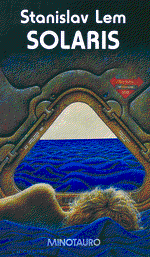
Solaris is a science fiction novel (1961), by Stanislaw Lem1 in which human explorers encounter
... a monstrous entity endowed with reason, a protoplasmic ocean-brain enveloping the entire planet and idling its time away in extravagant theoretical cognitation [sic] about the nature of the universe.
Lem develops the notion of an intelligence so huge and alien that any form of communication with it proves virtually impossible "like wandering about in a library where all the books are in an indecipherable language." But beyond the issue of how a dialogue with extraterrestrial intelligence might be established, Lem explores the motives behind why humans should seek such contact. In the words of one of his characters:
We are seeking only man. We have no need of other worlds... We are seeking for an ideal image of our own world: we go in quest of a planet, of a civilization superior to our won but developed on the basis of a prototype of our primeval past.
Lem's warnings of alien incomprehensibility and that we should endeavor to understand ourselves before we look to the stars, contrasts with a more positive approach to the cosmic quest found in the 20th century writings of such authors as David Lindsay, Olaf Stapledon, C. S. Lewis, and Arthur C. Clarke.
 |
The first film version of Solaris, directed Andrei Tarkovsky and released in 1972, is considered a science fiction movie classic. Gregory Benford, professor of physics at the University of California, Irvine, and author of the SF novel Timescape has remarked: "The 1972 Solaris is perhaps the only film to address the limits of science set by our constrained human perceptions, categories, and tendency to anthropomorphise. That it is also a compelling, tragic drama, not a mere illustrated lecture, makes it even more important." Solaris was remade by Steven Soderbergh in 2002.
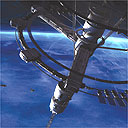 |
| The space station in Solaris. |
Reference
1. Lem, Stanislaw. Solaris, trans. by Joanna Kilmartin and Steve Cox. New York: Walker (1970).

