
cancer of the uterus
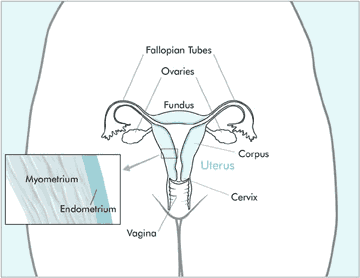
The uterus and associated structures.
The most common type of cancer of the uterus begins in the lining of the uterus, known as the endometrium. It is called endometrial cancer, uterine cancer, or cancer of the uterus. In this entry, the terms uterine cancer or cancer of the uterus will refer to cancer that begins in the endometrium.
A different type of cancer, uterine sarcoma, develops in the muscle of the uterus, known as the myometrium. Cancer that begins in the cervix is also a different type of cancer. This entry does not deal with uterine sarcoma or with cancer of the cervix.
Who is at risk?
No one knows the exact causes of uterine cancer. However, it is clear that this disease is not contagious. No one can "catch" cancer from another person.
Women who get this disease are more likely than other women to have certain risk factors. A risk factor is something that increases a person's chance of developing the disease.
Most women who have known risk factors do not get uterine cancer. On the other hand, many who do get this disease have none of these factors. Doctors can seldom explain why one woman gets uterine cancer and another does not.
Studies have found the following risk factors:
Women who use estrogen without progesterone have an increased risk of uterine cancer. Long-term use and large doses of estrogen seem to increase this risk. Women who use a combination of estrogen and progesterone have a lower risk of uterine cancer than women who use estrogen alone. The progesterone protects the uterus.
Women should discuss the benefits and risks of HRT with their doctor. Also, having regular checkups while taking HRT may improve the chance that the doctor will find uterine cancer at an early stage, if it does develop.
The benefits of tamoxifen to treat breast cancer outweigh the risk of developing other cancers. Still, each woman is different. Any woman considering taking tamoxifen should discuss with the doctor her personal and family medical history and her concerns.
Other risk factors are related to how long a woman's body is exposed to estrogen. Women who have no children, begin menstruation at a very young age, or enter menopause late in life are exposed to estrogen longer and have a higher risk.
Women with known risk factors and those who are concerned about uterine cancer should ask their doctor about the symptoms to watch for and how often to have checkups. The doctor's advice will be based on the woman's age, medical history, and other factors.
Signs and symptoms
Uterine cancer usually occurs after menopause. But it may also occur around the time that menopause begins. Abnormal vaginal bleeding is the most common symptom of uterine cancer. Bleeding may start as a watery, blood-streaked flow that gradually contains more blood. Women should not assume that abnormal vaginal bleeding is part of menopause.A woman should see her doctor if she has any of the following symptoms:
These symptoms can be caused by cancer or other less serious conditions. Most often they are not cancer, but only a doctor can tell for sure.
Diagnosis
If a woman has symptoms that suggest uterine cancer, her doctor may check general signs of health and may order blood and urine tests. The doctor also may perform one or more of the exams or tests described below.
Staging the disease
If uterine cancer is diagnosed, the doctor needs to know the stage, or extent, of the disease to plan the best treatment. Staging is a careful attempt to find out whether the cancer has spread, and if so, to what parts of the body.
The doctor may order blood and urine tests and chest X-rays. The woman also may have other X-rays, CT scans, an ultrasound test, magnetic resonance imaging (MRI), sigmoidoscopy, or colonoscopy.
In most cases, the most reliable way to stage this disease is to remove the uterus (hysterectomy). After the uterus has been removed, the surgeon can look for obvious signs that the cancer has invaded the muscle of the uterus. The surgeon also can check the lymph nodes and other organs in the pelvic area for signs of cancer. A pathologist uses a microscope to examine the uterus and other tissues removed by the surgeon.
These are the main features of each stage of the disease:

