
Wolf 359
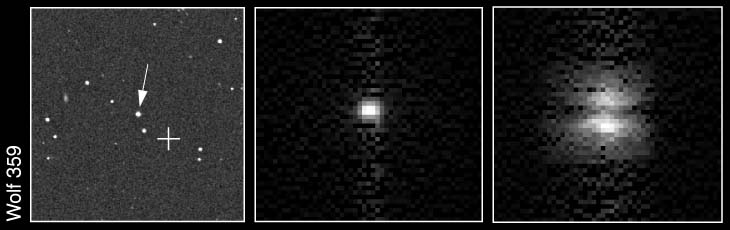
Hubble Space Telescope images of Wolf 359 Hubble.

Wolf 359. Image: ESO Online Digitized Sky Survey.
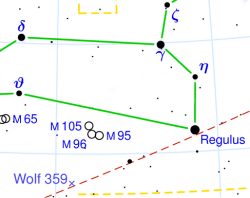
Wolf 359 lies almost on the ecliptic (red line) and quite close in the sky to the bright star Regulus. © 2003 Torsten Bronger.
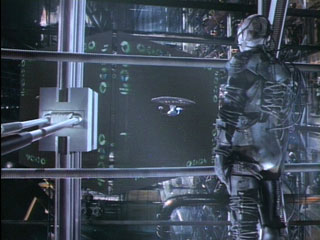
In the Star Trek universe, Wolf 359 was the scene of a battle in 2367 between the Federation and the Borg. This was depicted in the Next Generation episode "The Best of Both Worlds".
Wolf 359 is the fifth nearest star (third nearest star system) to the Sun, after the Alpha Centauri trinary and Barnard's Star. Wolf 359 lies in the northern constellation Leo. Discovered by Max Wolf in 1918, it is an extremely faint red dwarf that for 25 years was the least luminous star known. It is also a flare star with the variable star designation CN Leonis, and in 2001 became the first star, other than the Sun, to have its corona registered by near-optical ground-based detection when an emission line of highly ionized iron (Fe XIII at 3,388 Å) was reported.
In 1997, the Hubble Space Telescope (HST) in combination with the Faint Object Spectrograph (FOS) was used to search for faint companions – faint stellar or large sub-stellar objects, such as brown dwarfs – around Wolf 359. The images obtained (see above) showed no such orbiting body as close as 1 astronomical unit (AU), equivalent to an angular separation of 0.432 arcsec, from the star.
| visual magnitude | 13.44 |
| absolute magnitude | 16.55 |
| spectral type | M6.5Ve |
| luminosity (bol) | 0.0014 Lsun |
| distance | 7.78 light-years (2.386 pc) |
| position | RA 10h 56m 29.2s, Dec +07° 00' 53" |
| other designations | CN Leonis, GCTP 2553, GJ 406, G 045-020, LTT 12923, LFT 750, LHS 36 |
Science fiction connections
In the Star Trek universe, Wolf 359 was the scene of a battle in 2367 between the Federation and the Borg. This was depicted in the Next Generation episode "The Best of Both Worlds".
"Wolf 359" is the title of an episode of the original series of The Outer Limits in which a scientist creates a miniature version of a planet going around the star in his own laboratory on Earth.

