
Bacon, Francis (1561–1626)
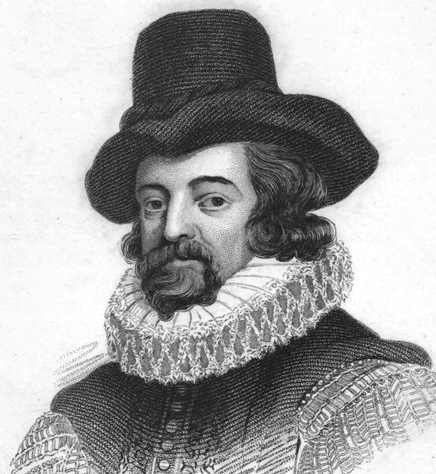
Francis Bacon was an English philosopher, statesman, and jurist who rose to become Lord Chancellor (1618–1621) to James I. He is chiefly remembered for the stimulus he gave to scientific research in England. Although his name is indelibly associated with the method of induction and the rejection of a priori reasoning in science, the painstaking collection of miscellaneous facts without any recourse to prior theory which he advocated in the Novum Organum (1620) has never been adopted as a practical method of research. The application of the Baconian method was, however, an important object in the foundation of the Royal Society of London some 40 years later.
In his unfinished utopian narrative The New Atlantis (originally published in Latin, 1627), Bacon depicted a society on a remote Pacific island that is ruled by an elite of benevolent scientists. Their methods of research foreshadow those of latter-day science, and their Solomon's House inspired by the creation of the Royal Society.
Bacon was also known as Lord Verulam and Viscount St. Albans.
A method for scientific inquiry
Bacon made no actual scientific discoveries; his achievement was to give to modern science its method, and to scientists their inspiration. Today, the work of scientists seems so obvious to us that we do not realize that they had once to be told what their methods should be: to observe nature; to conduct experiments; and to formulate natural laws. Bacon stressed the pragmatic (or practical) and inductive (testing a hypothesis by facts) method of science rather than the deductive (proving a hypothesis by reasoning) or system-building side, which still played so large a part in the work of Galileo. Bacon was the first great champion of empiricism – the pursuit of knowledge by experiment and observation.
Bacon's argument was typically English in its utility. The new science, he held, was not just an intellectual enterprise to give men knowledge of nature, but a practical undertaking to give them mastery over nature. Once men knew how nature worked, they could exploit it to their own advantage. Bacon foresaw, as no one before him had foreseen, how science could improve the condition of human life on earth.
Bacon was a true Renaissance man in his optimism and his great faith in humanity and the future. He pointed to such practical achievements as the geographical dis-coveries of Marco Polo, the scientific discoveries of Copernicus and Galileo, the introduction of printing, gunpowder, and the magnetic compass. All of these were "changing the world," and the world thus changed, he said, must have a "new philosophy." He once suggested that the bees provided the model for scientific inquiry; for science required that men should work together as a group, systematically, learning from experience by ordered observation, amassing data, storing it, interpreting it judiciously. Science also required men to break with their traditional prejudices, with magic and superstition. Bacon warned men particularly against their favorite "Idols"-first, the "Idols of the Tribe," or the tendency of men to believe what they want to believe; secondly, the "Idols of the Den," the defects that arise from individual crankishness and idiosyncrasies; thirdly, the "Idols of the Market Place," due to the corruption of language; and fourthly, the "Idols of the Theatre," arising from a veneration of traditional systems of philosophy. The "dragon" of Aristotelian thinking, he said, had to be killed decisively.
Aims and ambitions
Bacon's life was one of fluctuating fortunes. The impoverished son of one of the ministers of Elizabeth I, he rose by ruthless intrigue to several high offices of state. At the age of 60, having become chief minister to James I, he was found guilty of having accepted bribes, and forced to resign from public office. He devoted his remaining five years to study and learning. He is said to have gone one winter's day to stuff a dead chicken with snow to see if the cold would preserve its flesh; during the experiment he caught the chill that killed him.
Bacon's excuse for his faults – both his ambition and his intrigues – was that he needed power and money to do good in the world. For he did not merely formulate a new science of method, but also set forth a number of practical proposals. He wanted to build a great college, where men could pursue experimental studies; he wanted professors of science at the universities, and learned societies that would encourage research. In Bacon's imaginary society, described in The New Atlantis, there is a college of science called "Solomon's House," a place "dedicated to the study of the works and creatures of God." Bacon did not think that his costly schemes were impractical. He hoped that if, as a successful statesman, he could gain the king's support, the money might be found. He firmly believed that the best hope for mankind was to be ruled by an absolute king who, in turn, was instructed by a philosopher. But James I had too many theories of his own to listen to a court philosopher, and had been too elaborately trained in the old learning to lend himself to new ideas.
Bacon would have been luckier with Charles II, who was excited by science. For by Charles II's time – around 1660 –-the Baconian revolution in English science had been accomplished. Though in his lifetime Bacon met with little success, he inspired many with his dream of improving the lot of mankind by a new kind of science, and he had followers not only in England but throughout the civilized world. The Encyclopedist Diderot described Bacon as that "extraordinary genius" who "when it was impossible to write a history of what men knew, wrote the outline of what men had yet to learn."

