
cortisol
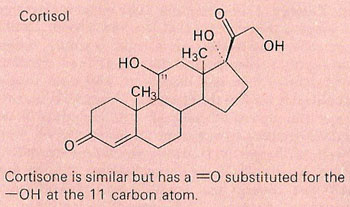
Cortisol is a hormone belonging to the class known as glucocorticoids, which affect almost every organ and tissue in the body. Cortisol is produced by the cortex of the adrenal glands. Its most important job is to help the body respond to stress. Among its many other vital tasks, cortisol
Because cortisol is so vital to health, the amount of cortisol produced by the adrenals is precisely balanced. Like many other hormones, cortisol is regulated by the brain's hypothalamus and the pituitary gland, a bean-sized organ at the base of the brain. First, the hypothalamus sends "releasing hormones" to the pituitary gland. The pituitary responds by secreting hormones that regulate growth and thyroid and adrenal function, and sex hormones such as estrogen and testosterone. One of the pituitary's main functions is to secrete adrenocorticotropic hormone (ACTH), a hormone that stimulates the adrenal glands. When the adrenals receive the pituitary's signal in the form of ACTH, they respond by producing cortisol. Completing the cycle, cortisol then signals the pituitary to lower secretion of ACTH.

