
rubidium
Rubidium is a soft, silvery-white, metallic element belonging to the family of alkali metals.
It was discovered in 1861 in Heidelberg by Robert Bunsen and Gustav Kirchhoff, by spectroscopic
examination of the mineral lepidolite; its name is derived from the Latin rubidus, meaning "red."
Rubidium is the 23rd most abundant element in Earth's crust, and is
found as a minor constituent of potassium and cerium minerals, notably pollucite, carnallite,
leucite and lepidolite. Metallic rubidium, prepared by electrolysis of the chloride or reduction of the carbonate, is used in electron tubes
and photoelectric cells, and its salts in making special glasses and ceramics. Chemically, it resembles sodium but is more reactive, igniting in
air and reacting violently with water. It forms amalgams with mercury and alloys with gold, cesium,
potassium, and sodium. Rubidium colors a
flame yellowish-violet. Its most common, and only stable, isotope is 85Rb (72.15%); three other isotopes are all radioactive. Rubidium-81
provides a useful source of krypton-81m
for use in ventilation-perfusion scanning. It has a half-life of about 4 hours and decays into krypton-81m, emitting radiation as it does
so.
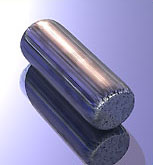 |
| Rubidium.
Credit: RSC
|
| atomic number | 37 |
| relative atomic mass | 85.468 |
| electron configuration | [Kr]5s1 |
| electron affinity | -46.9 (M-M-)/kJ mol-1 |
| melting point | 38.89°C (102°F) |
| boiling point | 688°C (1,270°F) |

