
subgiant
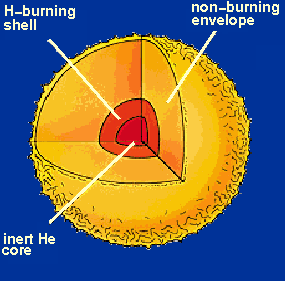
Structure of a subgiant.
A subgiant is a star that has stopped fusing hydrogen in its core and has begun to evolve off the main sequence, increasing in size and luminosity, on its way to becoming a red giant. Subgiants produce energy in a hydrogen-burning shell that surrounds the core. They are mainly of types F, G, and K and are placed in luminosity class IV. Subgiants are of smaller radius and lower luminosity than normal giant stars and lie between the main sequence and giant region of the Hertzsprung-Russell diagram.
The nearest example of a subgiant is Beta Hydrii, 24.4 light-years away. Beta Hydrii has an estimated mass of 1.1 solar masses, a luminosity 3.5 times that of the Sun, and a radius 1.5 times that of the Sun (see Hydrus for more details).

