
mouth

Fig 1. General anterior view of the human mouth.

Fig 2. Cross-section of the mouth.
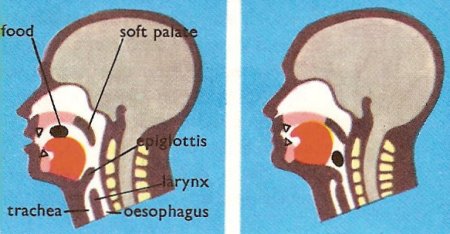
Fig 3. When one swallows, the soft palate and uvula seal off the nasal cavity, and the epiglottis seals of the trachea (windpipe). The tongue pushes the food backwards into the lumen (internal cavity) of the pharynx, and then into the digestive system.
The mouth, also called the oral cavity, is the first part of the gastrointestinal tract (or alimentary canal). The boundaries of the mouth are formed by the lips, cheeks, floor of the mouth, and palate. The mouth contains the teeth and tongue and receives secretions from the salivary glands. It performs three main functions, which have to do with digestion, breathing, and speech.
| Contents |
|---|
| Functions of the mouth |
| Structure of the mouth |
| Lips and cheeks |
| Palate |
| Tongue |
| Teeth |
| Tonsils |
| Salivary glands |
| Muscles of the mouth |
| Disorders of the mouth |
| The mouth in other species |
Functions
First, the mouth is the place where food is taken in and where digestion begins (see digestive system). The mouth is adapted to receive food by ingestion, break it into small particles by mastication, and mix it with saliva. The digestive functions of the mouth include:
Second, the mouth is a passageway between the pharynx (the cavity connecting the nose, mouth, and larynx) and the outside of the body. It can thus be used for breathing when the nose is inadequate, as happens, for instance, during strenuous exercise.
Third, the mouth plays a vital part in speech (see voice), because alterations in the shape of the mouth and the lips modify the sounds that are made by the vocal folds (vocal cords) in such a way that they become recognizable as syllables.
Structure
The mouth, like many organs in the human body, is a hollow cavity. The part in front of the teeth is called the vestibule, while the part behind is the mouth itself. The floor of the mouth is formed from sheets of muscle tissue which are attached to the inner surface of the jawbone, or mandible. The side walls are formed by the cheeks, which are sufficiently flexible to allow the mouth to open and close.
The roof of the mouth is formed by the palate, a thin sheet of tissue which separates the mouth from the nasal cavities above. At the back, the cavity of the mouth joins up with the pharynx, while at the front it communicates with the outside through the lips.
Except for the teeth, the whole of the inner surface of the mouth is lined by mucous membrane. At the back, the membrane goes on to line the gastrointestinal tract, and at the front it is folded over to form the lips.
Lips and cheeks
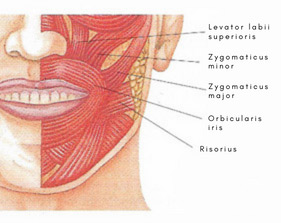 |
| A cmplex system of muscles is responsible for moving the lips to help form facial expressions and to shape the sounds of speech. For smiling, the levator labii superioris elevates the upper lip, while the zygomaticus major and minor and the risorius muscles pull the mouth and the corners of the lips upward and sideways. The orbicularis muscle around the mouth is used to produce speech. |
The lips and cheeks help hold food in the mouth and keep it in place for chewing. They are also used in the formation of words for speech.
A lip is one of two fleshy folds around the entrance to the mouth. Externally the lips are covered with skin and internally with mucous membrane, the relative transparency of which allows the red-pink of the underlying capillaries to show through.
The main substructure of the lips is a ring of muscle, whose functions including keeping food in the mouth, helping to produce speech and other sounds (whistling, for example), and kissing. Smaller muscles at the corners of the lips are responsible for facial expression. The lips contain numerous sensory receptors that are useful for judging the temperature and texture of foods.
Labial and buccal glands
The labial salivary glands are small, closely set mucus glands that lie in the submucous coat of the lips, and are palpable as little nodules when the tongue is pressed against the lip. Their ducts piece the mucus membrane and open into the vestibule of the mouth. he buccal salivary glands are similar mucus glands that lie in the submucous coat of the cheeks.
Palate
The palate forms the roof of the mouth and separates the mouth from the nasal cavity. The palate consists of two quite different parts. The anterior (front) portion, the hard palate, is supported by bone. The posterior (back) portion, the soft palate, is skeletal muscle and connective tissue. Posteriorly, the soft palate ends in a projection called the uvula. During swallowing, the soft palate and uvula move upward to direct food away from the nasal cavity and into the oropharynx.
Tongue
The tongue, which is made up of muscle fibers, is attached to the back part of the floor of the mouth. When it is not in use, it lies between the teeth and the lower jaw. Its most important tasks are to move the food about in the mouth during chewing and to assist in the making of sounds during speech. On the upper surface of the tongue are a large number of papillae that provide friction and contain the taste buds.
See main article on the tongue.
Teeth
In the human, a complete set of deciduous (primary) teeth contains 20 teeth. There are 32 teeth in a complete permanent (secondary) set. The shape of each tooth type corresponds to the way it handles food. At the front are eight chisel-shaped cutting teeth, or incisors. Behind these are the four canine teeth, and behind these are eight premolars and 12 molars.
See main article on teeth.
Tonsils
At the back of the mouth are two thin folds of tissue on each side which run from the soft palate above to the root of the tongue below. These folds are called the pillars of the fauces. There is an anterior (front) and a posterior (back) pillar on each side, and between these pillars lie the tonsils. The tonsils are two small glands made of lymphatic tissue.
See main article on the tonsils.
Salivary glands
The salivary glands are small glands, found in many parts of the mouth, which produce saliva. All of them lie beneath the mucous membrane. The largest salivary glands are the parotid glands which lie, one on each side, just in front of the ears. Other large ones are the submandibular glands, in the floor of the mouth, and the sublingual glands, underneath the tongue. Saliva moistens the food that we eat, which makes swallowing easier; it also helps in the digestive process, for it contains the enzyme amylase, which breaks down the starch in food.
Muscles of the mouth
The various parts of the mouth have to make numerous finely controlled movements in order that we may eat and speak. These movements are all brought about by the many muscles which lie under the mucous membrane, and which are attached to the skeleton, often some distance from the mouth.
Disorders
The most common deformities of the mouth, other than alignment of the teeth, are harelip (a split in the upper lip) and cleft palate (a gap in the roof of the mouth). Harelip and cleft palate may occur alone or together.
Infections of the mouth are common. Examples include an abscess around the root of a tooth and oral candidiasis (thrush), a fungal infection that produces sore, cream-colored patches on the lining of the mouth. Non-infective conditions that also cause discoloration include leukoplakia (in which there are thickened white or gray patches) and lichen planus (in which a white network of raised tissue develops).
Extremely common are mouth ulcers, painful white or yellow open sores that may develop anywhere on the mucous membrane within the mouth. Cysts (swellings filled with fluid or semi-solid material) sometimes occur on the lining of the cheek; ranula are cysts on the floor of the mouth.
Any lump, sore, or ulcer in the mouth that persists for more than three or four weeks should be seen by a doctor. In rare cases, the abnormality is an early sign of a malignant growth.
In other species
In flatworms, the mouth is the only opening into the digestive cavity, and is located on the "belly" of the worm.

