
gastrointestinal tract
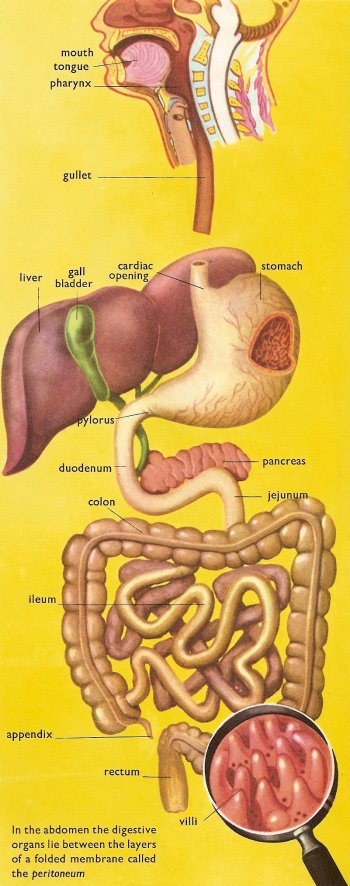
The gastrointestinal tract, also known as the digestive tract, alimentary canal, enteron, or gut, is the body cavity that extends between the mouth and the anus and in which food is digested and nutrients absorbed (see digestion). The gastrointestinal (GI) tract consists of the:
though some animals don't have all these regions. In humans, it is about 9 m (30 ft) long. Movement of food in the tract occurs by peristalsis, but is controlled at key points by sphincters. The gastrointestinal tract forms part of the digestive system.
The entire GI tract can be considered as a hollow tube surrounded by a wall composed of four main layers:
Mucosa
The mucosa consists of :
The epithelial lining of the mucosa forms a selective barrier between the external environment (lumen) and the body. All the food products that are digested and absorbed by the body need to pass through the epithelial lining. This epithelial lining may contain goblet cells, that secrete mucus for lubrication. Endocrine cells (part of the diffuse endocrine system) are common in the epithelium and produce polypeptide hormones, that play a role in the regulation of the digestive processes.
The lamina propria, situated just below the epithelium, consists of loose connective tissue, with an abundant blood supply. Lymphatic nodules, lymphocytes and plasma cells, and macrophages are common in the lamina propria and form a first line of immunological defense against bacterial and viral invasion.
The muscularis mucosa causes local muscular contractions in the mucosa.
Submucosa
The submucosa consists of dense connective tissue and Meissner's nerve plexus.
Muscularis
The muscularis consists of two sub-layers of smooth muscle cells (typically inner circular layer, outer longitudinal layer). These are involved in the peristaltic movements of the intestine. Between these two muscle layers is Auerbach's (myenteric) nerve plexus. The rhythmic peristaltic contractions of the muscularis are responsible for propelling and mixing food in the digestive tract. These movements are mainly generated by Auerbach's myenteric plexus. The neurons of the plexus can be visualized by silver impregnation techniques. It can be shown that the plexuses consist of aggregates of nerve cells in the form of small parasympathetic ganglia (see parasympathetic nervous system).
Serosa or adventitia
The serosa consists of a thin layer of loose connective tissue covered by a simple squamous epithelium (mesothelium). Serosa is present in the parts of the intestinal tract that are present in the peritoneal cavity. The regions of the intestinal tract that are not present in the peritoneal cavity are held in place by an outer layer of loose connective tissue (adventitia).

