
coronary angiography
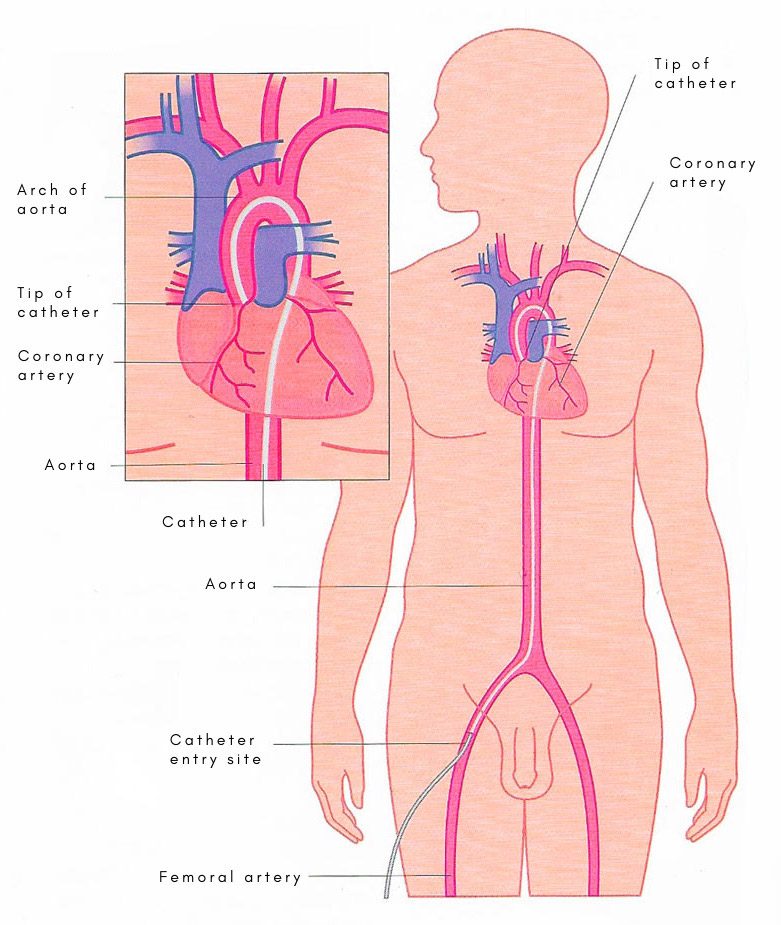
In coronary angiography, the catheter is positioned in the heart so that its tip rests in a coronary artery, and contrast dye is then injected. The artery and the small vessels leading from it are visualized by a series of X-rays.
Coronary angiography is a test that uses a special dye and X-rays to show the inside of the coronary arteries.
The coronary arteries supply blood and oxygen to the heart.
Coronary angiography is one of the main types of angiography.
A material called plaque can build up on the inside walls of the coronary
arteries and cause them to narrow. When this happens, it's called coronary
artery disease (CAD). CAD can prevent enough blood from flowing to the
heart and can lead to angina (chest discomfort
or pain) and heart attack. Coronary
angiography shows if a person has CAD.
Most of the time, the coronary arteries can't be seen on an X-ray. During coronary angiography, a special dye is injected into the bloodstream to make the coronary arteries show up on an X-ray.
To deliver the dye to the coronary arteries, a procedure called cardiac catheterization is used. A long, thin, flexible tube called a catheter is put into a blood vessel in the arm, groin (upper thigh), or neck. The tube is then threaded into the coronary arteries, and the dye is injected into the bloodstream. Special X-rays are taken while the dye is flowing through the coronary arteries.
Cardiologists (doctors who specialize in heart problems) usually perform cardiac catheterizations in a hospital. The patient is awake during cardiac catheterization. The procedure usually causes little to no pain, although some soreness may be felt in the blood vessel where the doctor puts the catheter.
Who needs coronary angiography?
Coronary angiography is a test for coronary artery disease (CAD). A person may need coronary angiography if he or she has signs or symptoms of CAD. These include:
A person also may need coronary angiography on an emergency basis if he or she is having a heart attack. This test combined with a procedure called angioplasty can open the blocked artery causing the heart attack and prevent further damage to the heart.
Coronary angiography also can help a doctor decide how to treat CAD after a heart attack. This is especially true if the heart attack caused major damage to the heart, or if the patient is still having chest pain.
Before coronary angiography
Before having coronary angiography, discuss with your doctor:
Your doctor will tell you exactly which procedures will be performed. For example, your doctor may recommend angioplasty if the angiography shows a blocked artery. You will have the opportunity to ask questions about the procedure, and you will be asked to provide written informed consent to have the procedures done.
It may not be safe to drive right after having cardiac catheterization. If your doctor says you can go home the same day as the test, you should arrange for a ride home from the hospital. You may have to stay overnight for this test.
During coronary angiography
During coronary angiography, you're kept on your back and awake. That way, you can follow your doctor's instructions during the test. You'll be given medicine to help you relax. This medicine may make you sleepy.
Your doctor will numb the area where the small plastic tube (catheter) will enter the blood vessel through a small cut in the arm, groin (upper thigh), or neck. The doctor then threads the catheter through the vessel up to the opening of the coronary arteries. Special X-ray movies are taken of the catheter as it's moved up into the heart. The movies help your doctor see where to position the tip of the catheter.
Your doctor will put a special dye in the catheter when it reaches the correct spot. This dye will flow through your coronary arteries and make them show up on an X-ray. This X-ray is called an angiogram. If the angiogram reveals blocked arteries, your doctor may use angioplasty to restore blood flow to your heart.
After your doctor completes the angiography, or the angiography and angioplasty, he or she will remove the catheter from your body. The opening left in the blood vessel will then be closed up and bandaged. A small sandbag or other type of weight may be put on top of the bandage to apply pressure. This will help prevent major bleeding from the site.
After coronary angiography
After coronary angiography, you will be moved to a special care area, where you will rest and be monitored for several hours or overnight. During this time, your movement will be limited to avoid bleeding from the site where the catheter was inserted. While you recover in this area, nurses will check your heart rate and blood pressure regularly and see if there is any bleeding from the tube insertion site.
A small bruise may develop on your arm, groin (upper thigh), or neck at the site where the catheter was inserted. That area may feel sore or tender for about a week. Be sure to let your doctor know if you develop problems such as:
Talk to your doctor about whether you should avoid certain activities, such as heavy lifting, for a short time after the procedure.
Risks
Coronary angiography is a common medical test that rarely causes serious problems. But complications can include:
Other less common complications of the test include:
As with any procedure involving the heart, complications can sometimes, although rarely, be fatal. The risk of complications with coronary angiography is higher if you have diabetes or kidney disease, or if you're 75 years old or older. The risk for complications also is greater in women and in people having coronary angiography on an emergency basis.

