
detection of extraterrestrial life
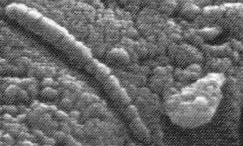
Purported fossil in meteorite ALH84001.
Astrobiologists are now on the threshold of the search for life on many other worlds, both within the Solar System and beyond. One of their immediate objectives is, therefore, to identify the means by which extraterrestrial life can be detected and recognized. Where life exists, or has existed, beyond Earth its presence may be disclosed in a variety of ways. Most obviously, if it is large, it may be identified visually at close range by the cameras of a spacecraft. However, with the possible exception of macroscopic marine life in the putative sub-surface oceans on Jupiter's large moons, this is an unlikely scenario for the foreseeable future. Instead, astrobiologists must rely upon more subtle methods which involve looking for key "signatures" or biomarkers of life. These may consist of chemical traces or microscopic fossils in extraterrestrial rocks or other samples that have been brought to Earth or, alternatively, collected for examination in situ, as in the case of the Viking landers. The difficulty researchers face in establishing whether certain substances or structures are biogenic or not, even when samples are available for detailed laboratory analysis on Earth, has been amply demonstrated by the recent, and on-going, martian "fossils" controversy. Many chemicals, including amino acids and polyaromatic hydrocarbons, can be produced easily both inorganically and as a result of metabolic processes in living things, so that other clues must be sought to establish their exact provenance. In the case of amino acids, a biogenic origin would be indicated by a heavy bias toward either the left-handed or right-handed forms of the molecules (although the possibility of terrestrial contamination, as always, would need to be ruled out). The presence of sulfides may also point to life, but in this case it would be important to use other evidence to estimate the temperature at which the sulfides had formed. In a hot environment, sulfides form readily enough by simple inorganic reactions, but at low temperatures the only known way in which they can come about is through enzyme-assisted metabolic activity. One of the current goals of astrobiologists is to compile a catalog of such possible signatures of life, much of the data for which will have to come from studying life in its varied forms on Earth and the evolution of biochemical pathways that yield preservable records.1
While space probes over the coming decade return ever-increasing amounts of data and samples pertinent to the search for life in the solar system, a new generation of telescopes will focus on the dim light reaching us from planets circling around other stars. Advanced space-borne optical interferometers will be capable not only of detecting extrasolar worlds and imaging their disks, but of analyzing the spectra of light reflected from their atmospheres and surfaces. On Earth, life has produced easily detectable atmospheric and surface changes, including high concentrations of molecular oxygen and ozone in the atmosphere, and a distinctive spectral feature due to chlorophyll on the ground. The signatures of these substances in the spectra of exoplanets would represent powerful, and almost incontrovertible, evidence for, at least, advanced plant life on a global scale. Yet, one billion years ago, the Earth itself might have appeared sterile to any remote alien observers who used only these criteria in their search for life. Recognizing the likelihood that much of the life in the Universe will be at the lower end of the evolutionary scale, astrobiologists must strive to understand better the atmospheric and surface spectral signatures of the Earth as they were, between about 1 and 4 billion years ago, when microbes were the loftiest organisms on this planet. At the other extreme, it may be that if we knew where and how to look we would find startling proof of very advanced life, including civilizations far ahead of us in their technological accomplishments (see extraterrestrial intelligence, more advanced than us). Some attempts have already been made to pick up messages from such beings (see SETI) or to detect other signs of their presence (see Dyson sphere; Bracewell probe; Kardashev civilization).
Reference
1. Pirie, N. W. "Introductory Remarks in a Discussion on the Recognition of Alien Life," Proceedings of the Royal Society of London, Series B, 189, 137 (1975). Other papers on this subject by C. Sagan, A. G. Cairns-Smith, J. E. Lovelock, and C. H. Waddington.

